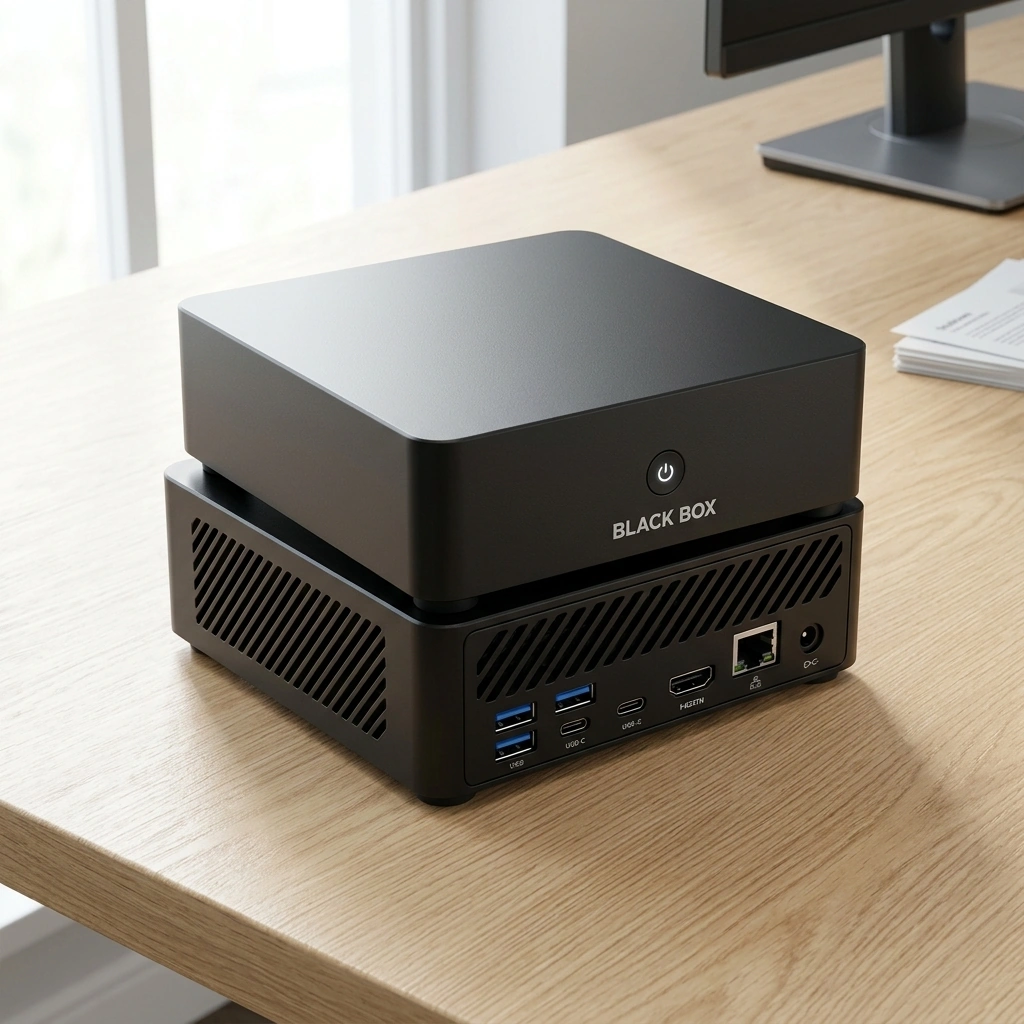
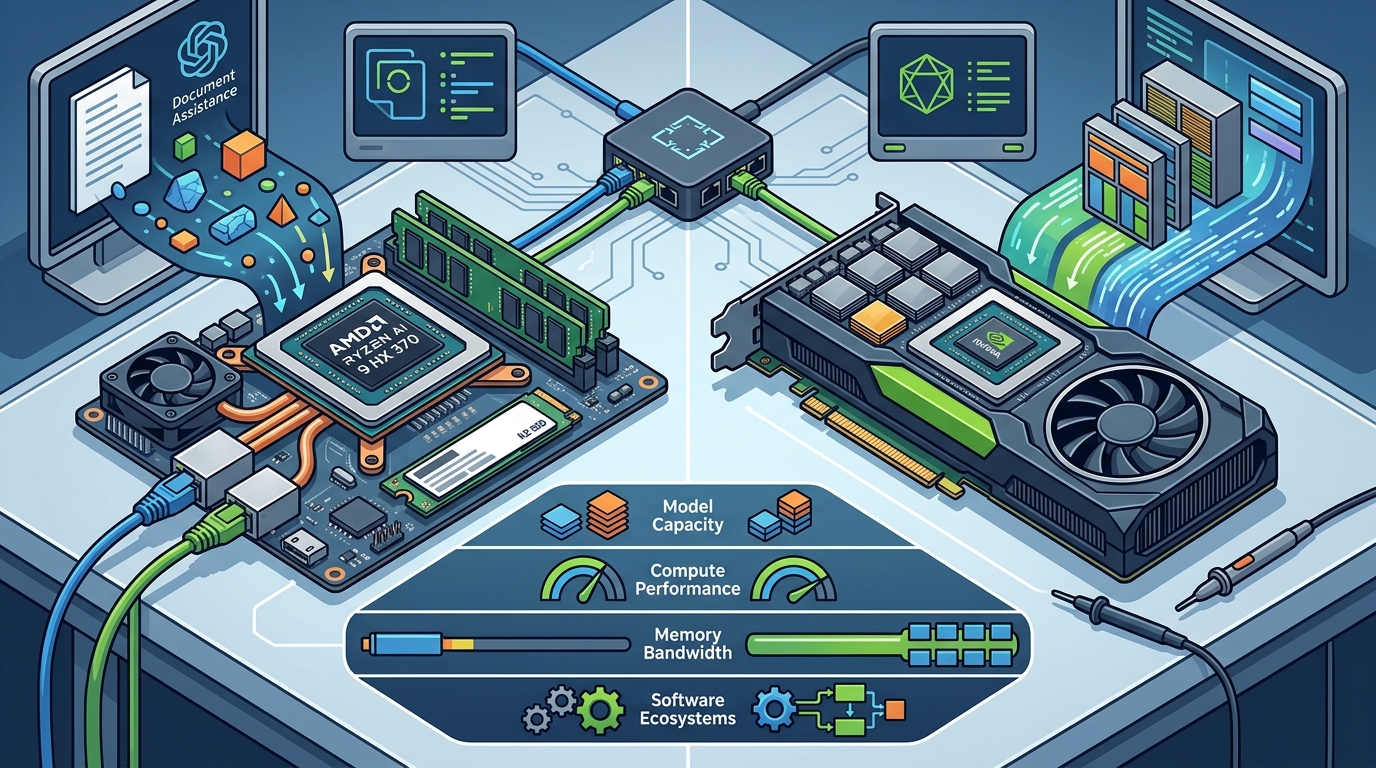
The AMD Ryzen AI 9 HX 370 and NVIDIA DGX Spark serve distinct roles in local AI inference. The Ryzen chip targets efficient, integrated desktop performance, while the DGX Spark focuses on high-bandwidth, dedicated AI compute. This guide compares their model capacity, compute performance, memory bandwidth, and software ecosystems to help you choose the right hardware for your Black Box Desktop AI setup.
Model Capacity Limits
Quantization Impact
Quantization reduces the precision of model weights, allowing larger models to fit into the same memory space. FP16 (16-bit floating point) requires roughly 2 bytes per parameter, while INT4 (4-bit integer) requires only 0.5 bytes. A 70-billion parameter model in FP16 requires about 140 GB of memory, which exceeds the 64 GB limit of the Ryzen platform. However, in INT4, it requires about 35 GB, fitting comfortably within the 64 GB unified memory of the Black Box system. For additional details, review the .
NPU/GPU Compute Performance
Efficiency vs Throughput
Efficiency is crucial for battery-powered or fanless desktop appliances. The Ryzen AI 9 HX 370 is designed to deliver high performance within a low power envelope, making it ideal for the compact Black Box form factor. The DGX Spark, being a dedicated workstation, prioritizes peak performance and may consume significantly more power. For users prioritizing silent operation and energy efficiency, the integrated approach of the Ryzen chip is advantageous. For users prioritizing maximum token generation speed regardless of power draw, the dedicated GPU in the DGX Spark may offer an edge. For additional details, review the Customer Experience.
Unified Memory Bandwidth
Bandwidth Specifications
Software Ecosystem Compatibility
Framework Support
Memory Bandwidth Constraints
Memory bandwidth constraints limit the speed at which a model can generate tokens. In large language models, the decoding phase is memory-bound, meaning the speed is limited by how fast the GPU can read the model weights from memory. The bandwidth of the memory subsystem is the primary determinant of tokens per second (TPS) during decoding. The DGX Spark's HBM memory provides a significant advantage here, allowing for higher TPS on large models. The Ryzen AI 9 HX 370's LPDDR5x memory, while efficient, has lower bandwidth, which can result in slower token generation for very large models. For additional details, review the Frequently Asked Questions.
Practical Implications
For smaller models (7-13 billion parameters), the difference in token generation speed between the two platforms may be less pronounced, as the models fit entirely in cache or have lower memory access patterns. For larger models (30-70 billion parameters), the bandwidth difference becomes critical. The DGX Spark will likely generate tokens faster, but the Ryzen platform will still provide usable performance for many applications, especially when prioritizing efficiency and form factor. For additional details, review the About.
Model Size Capacity
Context Window Considerations
Context window size is another factor in model capacity. A larger context window requires more memory for the KV cache. With 64 GB of memory, if 35 GB is used for the model weights, 29 GB remains for context and system overhead. This allows for a substantial context window, suitable for long-document analysis. The DGX Spark, with potentially higher memory capacity, may allow for even larger context windows or multiple models running simultaneously.
Token Generation Speed
Expected Performance Ranges
On a 7-billion parameter model, both platforms may achieve similar TPS, as the model is small enough to fit in cache. On a 70-billion parameter model, the DGX Spark may achieve significantly higher TPS due to its memory bandwidth advantage. The Ryzen platform will still provide usable TPS, but users should expect slower generation for the largest models. The exact numbers will vary based on the specific model, quantization method, and software optimization.
Key Takeaways
- The AMD Ryzen AI 9 HX 370 is optimized for efficiency and integrated performance, making it ideal for compact desktop appliances like the Black Box.
- The NVIDIA DGX Spark is a dedicated AI workstation with high-bandwidth HBM memory, offering higher peak compute and memory bandwidth.
- Model capacity on the Ryzen platform is limited by the 64 GB unified memory, supporting up to ~40-50 billion parameters in 4-bit quantization.
- Memory bandwidth is the primary bottleneck for token generation speed in large models, where the DGX Spark has a significant advantage.
- Software ecosystem compatibility favors NVIDIA due to CUDA's extensive support, but Overwatch OS on the Black Box aims to simplify this for end-users.
- For smaller models, the performance difference between the two platforms is less pronounced, with the Ryzen chip offering better efficiency.
- The choice between the two depends on priorities: efficiency and form factor (Ryzen) vs. peak performance and bandwidth (DGX Spark).
Frequently Asked Questions
Can the Ryzen AI 9 HX 370 run 70-billion parameter models?
Yes, but only in quantized formats like INT4. A 70-billion parameter model in INT4 requires about 35 GB of memory, which fits within the 64 GB unified memory of the Black Box Desktop AI. However, token generation speed will be limited by memory bandwidth.
Is the DGX Spark faster than the Ryzen AI 9 HX 370?
The DGX Spark is generally faster for large model inference due to its higher memory bandwidth and dedicated GPU. However, the Ryzen chip is more efficient and better suited for compact, low-power desktop appliances.
What is the role of the NPU in the Ryzen AI 9 HX 370?
The NPU is a dedicated neural processing unit optimized for low-power, sustained inference tasks. It can handle specific AI workloads more efficiently than the CPU or GPU, extending battery life and reducing power consumption.
Does Overwatch OS support CUDA?
Overwatch OS is designed to abstract the underlying hardware, supporting both AMD and NVIDIA GPUs. It may use ROCm for AMD hardware and CUDA for NVIDIA hardware, providing a unified interface for users.
How much memory is needed for a 13-billion parameter model?
A 13-billion parameter model in FP16 requires about 26 GB of memory. In INT4, it requires about 6.5 GB. Both fit comfortably within the 64 GB memory of the Black Box Desktop AI, leaving ample space for context and system overhead.
Is local inference on the Ryzen chip secure?
Local processing by default, with owner-controlled permissions, ensures that data stays on the device. However, local processing does not guarantee complete security or regulatory compliance. Users should review their specific security requirements and use appropriate safeguards.
Conclusion
The choice between the AMD Ryzen AI 9 HX 370 and the NVIDIA DGX Spark depends on your specific needs. The Ryzen chip offers an efficient, integrated solution ideal for compact desktop appliances like the Black Box Desktop AI. The DGX Spark provides higher peak performance and memory bandwidth, making it suitable for dedicated AI workstations. For individuals and small businesses prioritizing ease of use, data control, and form factor, the Black Box with its Ryzen-based architecture is a compelling option. To explore the Black Box Desktop AI and its capabilities, visit Black Box Desktop AI. Learn more: https black boxai dough.